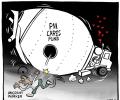
India Inc's philanthropic spends have grown by 3.62 per cent to Rs 22,000 crore in FY21 as profits expanded, and a majority of the allocations have been done to pandemic-linked causes, a report said on Tuesday. The report by rating agency Crisil said that while the first wave saw greater spending in cash largely through the PM-CARES Fund, the preference shifted to more direct support through in-kind spends in the second wave. Corporate contributed only Rs 85 crore to the PM-CARES Fund during the second wave between March and June 2021, as against Rs 831 crore to what was classified as 'others'.

While most experts suggest the government loosen its purse strings and not worry about the fiscal deficit in a pandemic impacted year, it will be a tightrope walk for the government to increase spending without going overboard.

The country's exports surged 49.85 per cent to $35.43 billion in July on account of healthy growth in petroleum, engineering, and gems and jewellery segments, even as the trade deficit widened to $10.97 billion during the month, official data showed on Friday. Imports during the month also rose by about 63 per cent to $46.40 billion, as per the data released by the commerce ministry.

State Bank of India, the country's largest lender, plans to hire 11,000 people in the current financial year as it expands operations.

Reserve Bank Governor Shaktikanta Das on Friday said 67 per cent of the decline in the foreign exchange reserves since April was due to valuation changes arising from strengthening US dollar and higher American bond yields. The forex reserves, which stood at $606.475 billion as on April 2, have declined to $537.5 billion as on September 23. It was also the eighth straight week when the reserves declined.

'We should look at is full year's growth rather than quarter numbers.'

Theoretically, the currency with the public should expand in sync with the nominal income, which again moves in relation to the nominal growth rate of the economy. But the correlation breaks easily when other factors come into play, says Anup Roy.

The key risks against a fast recovery would include long delays in business travel resumption, delays in commissioning, etc.

GST collections in February grew 18 per cent to over Rs 1.33 lakh crore in February even as the Omicron wave dented the month-on-month collection momentum. This is for the fifth time in the current fiscal that the Goods and Services Tax (GST) collection has crossed Rs 1.30 lakh crore mark. Also, this is the first time, cess collection has crossed the Rs 10,000 crore mark, signifying recovery in certain key sectors, especially automobile sales, the finance ministry said on Tuesday.
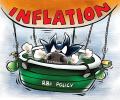
Reserve Bank on Wednesday said it expects retail inflation at 5.2 per cent in the first half of the current fiscal and revised downwards the target to 5 per cent for the quarter ended March. While headline inflation at 5 per cent in Feb 2021 remains within the tolerance band, some underline constituents are testing the upper tolerance level. Going forward, the food inflation trajectory will critically depend on the temporal and special progress of southwest monsoon in the 2021 season, RBI Governor Shaktikanta Das said on Wednesday while announcing the first monetary policy for the current fiscal. Reserve Bank of India (RBI) has kept the key repo rate unchanged at 4 per cent to support growth in the current situation.

Moody's Investors Service on Thursday slashed India's economic growth projection for 2022 to 7.7 per cent, saying that rising interest rates, uneven monsoon, and slowing global growth will dampen economic momentum on a sequential basis.

The cost of debt-funds for the states has touched the highest level so far this fiscal with the weighted average cut-off crossing the 7.16 percentage points at the latest auctions, up 11 bps over the past week, reflecting the hardening yields even for the government securities. The hardening of the rates at the first auction of the quarter comes in the wake of the expected large supply of debt from the states, as indicated for Q4 at Rs 3.2 lakh crore, up by Rs 10,000 crore. Nine states on Tuesday raised Rs 18,900 crore at the latest auction of state development loans.

Do the actual numbers bear out the claims made by the government or do they suggest something else? asks A K Bhattacharya.

Nirmala Sitharaman's messaging was clear when she presented a well-balanced Budget with an eye on state elections in nine states followed by a general election next year, observes Ramesh Menon.

The move towards indigenisation of defence procurement creates new opportunities for India's military industrial sector. The Government of India (GoI) has so far released five lists of items for positive indigenisation - these should be manufactured in India, rather than imported. Each item on these lists represents an opportunity for some local firm.

'The fiscal pressure will be there, but the intent of the government behind this move is to spur demand and growth.'

'Any normalisation exercise will bring its share of volatility.'

Life insurers' new business premium (NBP) reported stellar performance in November after a poor showing in October, on the back of strong growth in group single premiums for both private insurers and Life Insurance Corporation (LIC) of India. In November, 24 life insurers, including LIC, reported NBP to the tune of Rs 27,177 crore, up 42 per cent year-on-year (YoY) from the year-ago period. Private insurers' NBP rose 58.63 per cent YoY to Rs 11,209.75 crore as group single premiums more than doubled during this period.

While weather forecasters remain divided on how the monsoons will play out in India over the next few months, analysts believe the news at the current juncture - at best - can trigger a knee-jerk reaction in the markets. They believe it is too early to say whether the sub-par monsoon on account of El Nino can seriously dent the market sentiment in the short-to-medium term. "These are just initial forecasts and we will have another round / status update from the weather forecasters a month down the line.

A sharp rally in domestic stocks from June lows has once again rendered Indian markets expensive to their emerging-market (EM) peers. The 12-month forward price-to-earnings (P/E) multiple for the Nifty50 Index is around 20.6x - 82 per cent higher than 11.3 per cent for the MSCI EM Index. India's valuation premium has hit a five-month high. This is on the back of sharp outperformance to EM and global peers from June lows and also due to earnings downgrades, following the April-June quarter of 2022-23 earnings.

In years past, we often approached the Budget expecting to see changes in direct and indirect taxes. Those days are behind us. The Budget of today seeks to expand the economy and keep it at the forefront of technology, observes Harsh Goenka.

Banks' bad loans might cross Rs 10 lakh crore by the end of this fiscal, mainly on account of slippages in retail and MSME sectors, a study said on Tuesday. "NPAs are expected to rise to 8.5-9 per cent by March 2022, driven by slippages in retail, Micro, Small and Medium Enterprise (MSME) accounts, besides some restructured assets," the study by industry body Assocham and ratings firm Crisil said. The study titled 'Reinforcing the Code' said the Gross Non-Performing Assets (GNPAs) of banks are expected to cross Rs 10 lakh crore by March 2022.

Moody's said India's current account deficit (CAD) has narrowed significantly from 4.8 per cent in 2012 to 1.4 per cent in 2014.
The government on Tuesday announced Rs 900-crore allocation in the Budget for the newly set up Ministry of Cooperation for the 2022-23 fiscal, besides slashing Alternate Minimum Tax (AMT) on cooperative societies to 15 per cent and surcharge to 7 per cent, which nodal minister Amit Shah hailed saying it will boost the sector. Of the total allocation for the next fiscal, a significant amount of Rs 350 crore has been provided for digitisation of Primary Agriculture Cooperative Societies (PACs), while Rs 274 crore for an umbrella scheme 'Prosperity through Cooperatives' which would have a number of sub-components with the aim of all-round development of cooperatives in the country. For the first time, a separate budget of Rs 11 crore has been provided to Vaikunth Mehta National Institute of Cooperative Management (VAMNICON).
PSU divestment, LIC IPO, fiscal deficit: Budget 2021 marks a clear change in the Modi government's stance from fiscal conservatism to growth orientation.

While a DFI will help banks derisk their loan portfolios, creation of a bad bank will clean up their balance sheets.

'Investors need to have a fairly diversified basket of funds within equities.' 'We want them to allocate to largecap funds, midcap funds and flexicap schemes.'

India, he said, has already taken a host of reforms in banking and other sectors and is now focussing on stepping up public investment. "Compared to other nations, even among advanced countries, I think India is relatively better placed for the simple reason that India paid a certain price last decade... we had a banking system stress which was then compounded by stress in the non-banking financial sector towards 2018," he said at Amazon Smbhav Summit.

Surplus liquidity in the banking system as measured by absorption of excess funds by the Reserve Bank of India (RBI) fell sharply at the end of the last week due to outflows on account of advance tax payments. According to the RBI data, the net liquidity absorbed by the central bank on September 16 was at Rs 3,243.57 crore, much lower than the average of Rs 56,809.92 crore in the preceding four days of the week. The average absorption of funds by the RBI so far in September is at Rs 1.13 trillion, against the average of Rs 1.2 trillion in the previous month, the data showed.

Amit Shah's net worth grew 32 per cent to Rs 37.91 crore, mainly due to 80 per cent appreciation in the market value of his securities.

India's exports jumped 45.76 per cent to $33.28 billion in August on account of healthy growth in segments like engineering, petroleum products, gems and jewellery and chemicals, even as the trade deficit widened to a four-month high of $13.81 billion.

'We revolutionised the system in a manner so that the chances of leakage will be much lower than it was in the beginning.'

Almost 80 per cent of all income losses during the first wave of the pandemic in 2020 were incurred by the private sector in India, while in many other countries the entire loss was on respective governments, a report said on Wednesday. While the Centre had announced a Rs 21 lakh crore COVID-19 relief package, comprising 10 per cent of the GDP, the actual financial support was only about 2 per cent of GDP, as the rest was all credit-driven. "Almost four-fifths of all income losses during the pandemic in 2020 were incurred by the private sector in the country, while the government sector bore only about a fifth of the losses.

Senior citizens and others depending upon income from bank fixed deposit (FD) schemes will be at the receiving end with the retail inflation exceeding the interest rates. The Reserve Bank of India (RBI) in its latest monetary policy review has projected retail inflation at 5.3 per cent for the current financial year. Last week, the RBI said that the Consumer Price Index (CPI)-based inflation is now projected to be at 5.3 per cent for 2021-22 with risks evenly balanced.

'If you look at this Budget, except for the Rs 2 increase in petrol and diesel, there is no positive or negative impact from the Budget for the common man.'

'Kindling the private sector's animal spirits is more important than focusing on how government can give jobs on its own.'

The vaccination drive was only one important part of India's globally recognised pandemic management and response strategy, observes Dr Vinod K Paul.

Crisil Ratings on Wednesday said a broad-based recovery is on for India Inc currently, and upgraded its credit quality outlook to 'positive' from the earlier 'cautiously optimistic'. The rating agency said the credit ratio, which illustrates the number of upgrades to downgrades, rose to over 2.5 times in the first four months of the fiscal, as compared to 1.33 times in the second half of FY21, it said in a statement. The rating agency said it has also done a study of 43 sectors, excluding the financial sector, accounting for 75 per cent of the overall Rs 36 lakh crore in outstanding debt, which shows that the current recovery is broad-based.

India's current account surplus moderated to $15.5 billion or 2.4 per cent of the GDP in the July-September quarter of the current fiscal, the RBI said on Wednesday. The same was at $19.2 billion or 3.8 per cent of the GDP in the preceding three-month period on account of a rise in the merchandise trade deficit, the RBI said in a statement on 'Developments in India's Balance of Payments during the Second Quarter (July-September) of 2020-21'. It is for the third consecutive quarter that India's current account remained in surplus. In the last quarter of 2019-20, the surplus was $0.6 billion. Current account deficit/surplus reflects the difference between the outflow and inflow of foreign exchange in a country's current account.

The negative aspect about the Budget is that the capital expenditure has been marginally cut to achieve the fiscal deficit target assumptions, and the onus of sustaining investment demand till private capex revives continues to vest with the public sector enterprises, notes Jyotivardhan Jaipuria.
